
25.08.10 - Prompts Evolve! Beyond Words—Finer Control with JSON Code
Until now, when generating content with prompts, different tools would interpret the same wording in different ways, sometimes producing completely different results from identical text. Conveying subtle nuances such as lighting, camera angle, and mood through words alone was especially difficult.

The Traditional Challenge
Until now, when generating content with prompts, different tools would interpret the same wording in different ways, sometimes producing completely different results from identical text.
Conveying subtle nuances such as lighting, camera angle, and mood through words alone was especially difficult.
A New Era with JSON Code
Now, by using JSON code, we can eliminate ambiguity and achieve far more precise instructions.
Before:
"Create a video with bright lighting and a warm atmosphere" → Interpreted differently by every tool
After using JSON:
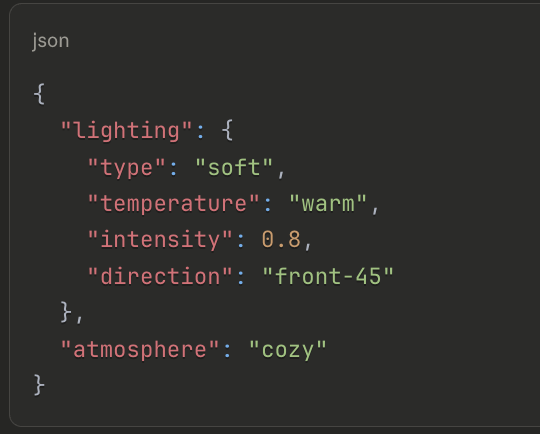
A Real Example: Applying This to Video Generation
In video generation, for instance, vague lighting instructions have often led to results that didn't match expectations. But with JSON code, you can precisely specify:
- Type of lighting (natural light, studio light, backlighting, etc.)
- Color temperature (specific values for warm/cool tones)
- Light intensity (specified on a 0–1 scale)
- Light angle (45 degrees from the front, directly overhead, side lighting, etc.)
All of these can be defined accurately using numerical parameters.
Benefits
✅ Reproducibility - The same code always produces the same result
✅ Precision - Control fine details that words alone can't capture
✅ Efficiency - Dramatically reduce trial and error
✅ Shareability - Easily share settings across your team
Conclusion
The next stage of prompt engineering is "codification." By combining creative expression with technical precision,
the quality of AI-generated content will improve dramatically.
We encourage you to try using JSON code to create exactly the content you envision!